
 Service - Magento2 Installation on Windows
 Subtotal: $65
- Published: Aug 31, 2026 | Updated: Sep 25, 2026

Magento vs Shopify: Which Ecommerce Platform Is Right for Your Business?
Table of Contents
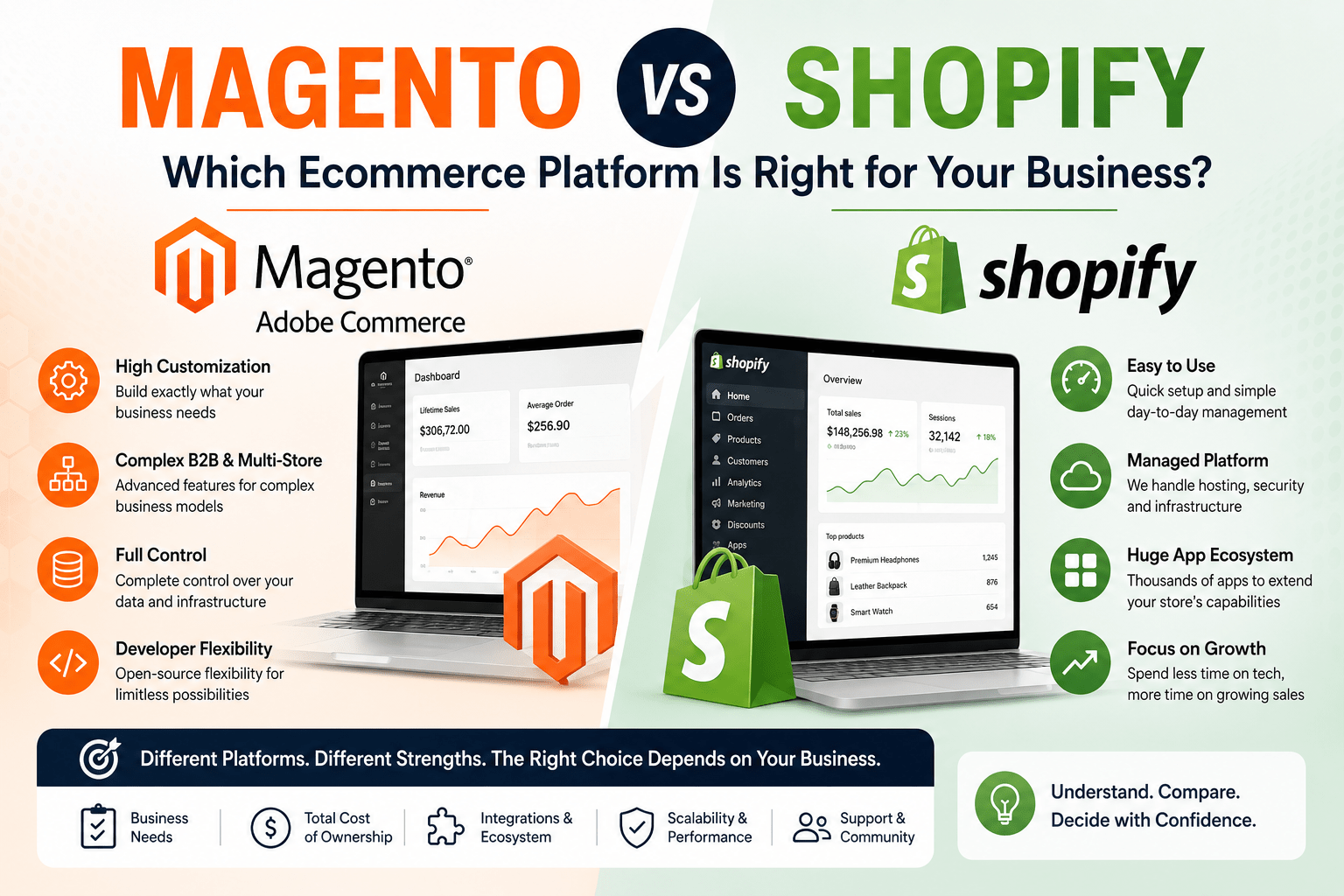
Magento vs Shopify is not simply a comparison between two ecommerce platforms. It is a choice between two fundamentally different approaches to building and operating an ecommerce business.
Shopify emphasizes managed infrastructure, operational simplicity, and a platform ecosystem that allows merchants to focus more of their resources on commerce.
Magento—now part of the Adobe Commerce ecosystem—provides a highly extensible commerce foundation with significantly more control over the underlying application and architecture.
Both can support serious ecommerce businesses.
The question is not:
Which platform is more powerful?
It is:
Which platform provides the right balance of capability, control, complexity, cost, and operational responsibility for your business?
That is the question this guide is designed to answer.
Magento vs Shopify: The short answer
If you want the simple answer:
Shopify is generally a stronger choice when you prioritize:
- Managed infrastructure
- Simpler operations
- Faster implementation
- Lower infrastructure responsibility
- Predictable platform management
- A large ecosystem of apps and integrations
- Rapid experimentation
Magento / Adobe Commerce is generally stronger when you need:
- Extensive customization
- Complex business rules
- Deep control over the commerce application
- Complex catalogs
- Sophisticated B2B requirements
- Multiple websites, stores, or views
- Complex integrations
- Greater control over the underlying technology
But there is an important caveat:
More capability does not automatically create more business value.
If your business does not need Magento’s additional flexibility, that flexibility can become unnecessary complexity.
Likewise, Shopify’s simplicity becomes less valuable if your business requirements constantly push against the platform’s architecture.
Magento vs Shopify at a glance
| Factor | Shopify | Magento / Adobe Commerce |
|---|---|---|
| Platform model | Managed SaaS | Extensible commerce platform |
| Infrastructure | Managed by Shopify | Greater merchant/partner responsibility depending on deployment |
| Technical control | Lower | Much higher |
| Customization | Strong within Shopify architecture | Very high |
| Operational complexity | Generally lower | Generally higher |
| Hosting responsibility | Low | Higher |
| Development requirements | Lower for standard commerce | Higher for complex customization |
| B2B | Native capabilities, with advanced features varying by plan | Deep B2B capabilities in Adobe Commerce |
| Multi-store | Supported | Strong multi-site/store architecture |
| Integrations | APIs, apps and ecosystem | APIs, extensions and custom integrations |
| Time to launch | Generally faster | Generally more involved |
| Best fit | Businesses prioritizing simplicity and managed commerce | Businesses with complex requirements and strong need for control |
The table gives you the direction.
The rest of the decision comes from understanding why these differences matter to the business.
First: Magento and Adobe Commerce are not exactly the same thing
This distinction is important.
Magento Open Source is the open-source commerce codebase.
Adobe Commerce is Adobe’s commercial commerce offering built on that foundation, with additional enterprise capabilities and services.
Adobe describes Adobe Commerce as a B2B and B2C commerce platform with API-first integrations, customizable extensions, and deployment options ranging from on-premises to managed cloud.
Magento Open Source continues to receive releases, security updates, and platform improvements. Adobe’s current documentation shows active 2.4.x release lines and ongoing development.
Therefore, when someone searches:
Magento vs Shopify
the comparison can actually mean:
Magento Open Source vs Shopify
or:
Adobe Commerce vs Shopify
Those are not identical commercial and technical decisions.
For a serious business, you should identify which Magento/Adobe Commerce product is actually being evaluated before comparing costs or capabilities.
What is Shopify?
Shopify is a hosted SaaS ecommerce platform.
The platform manages much of the underlying infrastructure, allowing merchants to build and operate ecommerce stores without directly managing the application server, operating system, database infrastructure, and much of the underlying platform stack.
Shopify’s current plans include online storefront capabilities, themes, inventory, sales channels, and ecommerce functionality, while Shopify Plus adds additional enterprise capabilities.
The strategic benefit is straightforward:
You give up some infrastructure control in exchange for reduced infrastructure responsibility.
That can be extremely valuable.
A business can spend more time on:
- Merchandising
- Marketing
- Customer experience
- Product
- Sales
- Operations
- Growth
and less time managing:
- Servers
- Platform upgrades
- Infrastructure
- Security patches
- Database optimization
- Deployment infrastructure
That doesn’t eliminate development work.
Shopify stores can still require sophisticated:
- Customizations
- Integrations
- APIs
- Themes
- Apps
- Automation
- Analytics
- Data architecture
But the underlying platform is much more managed.
What is Magento?
Magento is an open-source ecommerce platform and codebase that provides a much greater degree of control over the application and environment.
Adobe’s current documentation describes Magento Open Source as the code base Adobe contributes to and maintains for compatibility with Adobe Commerce.
Magento’s architecture can support:
- Complex catalogs
- Multiple websites
- Multiple stores
- Multiple store views
- Multiple currencies
- Different regional configurations
- Complex customer groups
- Custom pricing
- Extensive integrations
- Custom business logic
Adobe’s documentation specifically describes a hierarchy of websites, stores, and store views that can support multiple sites and localized experiences from a single instance.
That flexibility is one of Magento’s biggest strengths.
But it also creates responsibility.
The fundamental difference: control vs simplicity
This is the most important concept in the Magento vs Shopify decision.
Shopify
Less infrastructure control
↓
Less infrastructure responsibility
Magento
More control
↓
More responsibility
That is not a flaw in either platform.
It’s a trade-off.
The mistake is choosing one without understanding which side of the trade-off your business actually needs.
Magento vs Shopify: Customization
This is one of Magento’s strongest areas.
A Magento implementation can be extensively customized across:
- Catalog
- Pricing
- Customer accounts
- Checkout
- Promotions
- Product logic
- Order workflows
- Integrations
- Backend processes
- Storefront
- Data
- APIs
Magento Open Source uses Composer for package management and has a substantial PHP-based application architecture. Adobe’s current package documentation shows the platform’s extensive dependency ecosystem.
This provides significant technical freedom.
But here’s the part that businesses often miss:
Customization is not free.
Every custom feature potentially creates:
- Development cost
- Testing requirements
- Upgrade complexity
- Security considerations
- Maintenance
- Documentation requirements
- Dependency risk
Therefore:
Magento’s ability to customize is an advantage only when the customization creates meaningful business value.
Shopify customization works differently
Shopify is also highly extensible.
Businesses can use:
- Apps
- APIs
- Themes
- Extensions
- Shopify Functions
- Checkout extensibility
- Custom integrations
But these capabilities exist within Shopify’s platform architecture.
The distinction is:
Magento
Customize more of the underlying commerce system.
Shopify
Extend a managed commerce system.
For many businesses, the second model is preferable.
For some businesses, the first is essential.
Magento vs Shopify: Cost
This is one of the most misunderstood comparisons.
You cannot realistically compare:
Shopify monthly subscription
against:
Magento software cost.
The actual cost of running either platform depends on the entire architecture.
Shopify total cost
A Shopify business may incur:
- Platform subscription
- Payment processing
- Third-party transaction fees where applicable
- Apps
- Theme costs
- Development
- Custom integrations
- Agency/partner costs
- Data migration
- Additional services
Shopify’s current India pricing shows plans ranging from entry-level subscriptions to Shopify Plus, with Shopify Plus currently starting at ₹175,000/month on its India pricing page; actual enterprise costs can vary based on contract, business model, and requirements.
So Shopify isn’t necessarily “cheap.”
Its financial advantage may instead come from lower infrastructure and operational complexity.
Magento total cost
Magento costs can include:
- Hosting or managed cloud
- Development
- Infrastructure
- Security
- Monitoring
- Performance optimization
- Extensions
- Custom modules
- Integrations
- Maintenance
- Upgrades
- QA/testing
- DevOps
- Technical support
- Agency or internal engineering resources
Magento Open Source can reduce software licensing costs compared with commercial platforms.
But the business still has to pay for the system around the software.
That’s why:
Open source does not mean zero cost.
The correct financial comparison
Instead of asking:
“Which platform is cheaper?”
Calculate:
3–5 year Total Cost of Ownership
TCO =
Platform
- hosting
- infrastructure
- development
- apps/extensions
- integrations
- maintenance
- security
- support
- internal staff
- migration
- training
- opportunity cost
Then compare the expected business value.
That is a much more meaningful platform decision.
Magento vs Shopify: Performance
This is another area where simplistic comparisons fail.
People often ask:
Which is faster?
The honest answer is:
It depends on the implementation.
Magento performance can depend on:
- PHP
- Database
- MySQL
- Redis
- Caching
- CDN
- Search
- Extensions
- Custom modules
- Queries
- APIs
- Hosting
- Infrastructure
- Frontend implementation
Shopify performance can depend on:
- Theme
- JavaScript
- Apps
- Images
- Third-party scripts
- Tracking
- Storefront implementation
So the platform alone doesn’t determine performance.
A better question:
Can this platform and our implementation consistently meet the performance requirements of the business?
That’s the question an experienced technology partner should ask.
Magento vs Shopify: Scalability
Both can support substantial ecommerce businesses.
But scalability isn’t just about orders per minute.
You should consider:
- Traffic
- Orders
- Catalog size
- Customers
- Search
- Checkout
- Inventory
- ERP synchronization
- APIs
- Warehouses
- Markets
- Brands
- B2B
- Operational complexity
Shopify’s managed infrastructure reduces the amount of infrastructure engineering required from the merchant.
Magento gives businesses much greater architectural control when scaling complex commerce systems.
Adobe Commerce is designed to support multiple websites, brands, regions, and markets through its multi-site architecture.
So:
Shopify
Scale with less infrastructure responsibility.
Magento
Scale with greater architectural control.
Again, the right answer depends on the organization.
Magento vs Shopify: B2B
This is one area where the comparison has changed significantly.
Shopify has expanded its native B2B capabilities. Shopify currently makes B2B functionality available across Basic, Grow, Advanced, and Plus plans, although capabilities differ by plan.
For example, Shopify currently provides B2B functionality including:
- Companies
- Company locations
- Catalogs
- Customer-specific pricing
- Quantity rules
- Volume pricing
- Payment terms
Higher-tier Shopify Plus capabilities include unlimited B2B catalogs, direct catalog assignment to companies/locations, deposits, partial payments, and other advanced capabilities.
This is important because older Magento-vs-Shopify articles often make the mistake of saying:
“Magento is for B2B; Shopify is for B2C.”
That is no longer an accurate way to frame the decision.
Magento/Adobe Commerce still has deep B2B capabilities, including company structures, buyer roles, permissions, quotes, purchasing workflows, payment terms, and other complex requirements.
The real question is:
How complex is your B2B model, and how much of it can your chosen platform support without excessive customization or operational complexity?
Magento vs Shopify: Multi-store and international commerce
This is another area where Magento’s architecture can be particularly valuable.
Adobe’s documentation describes a single Commerce instance supporting multiple websites, stores, and store views, including different domains, categories, products, languages, currencies, and configurations.
Adobe also positions its commerce architecture for multiple brands and markets with centralized management.
Shopify also supports multiple markets and higher-level expansion capabilities, particularly through Shopify Plus.
Shopify Plus currently supports expansion stores, multiple markets, and organization-level capabilities designed for larger operations.
Therefore, neither platform should simply be labeled:
“Good for international.”
Instead, evaluate:
- Number of countries
- Number of brands
- Catalog differences
- Currency requirements
- Local pricing
- Tax
- Payment methods
- Inventory
- Fulfillment
- SEO
- Content
- Customer accounts
- ERP integration
Magento vs Shopify: Integrations
This is where the platform decision becomes architectural.
Your ecommerce platform rarely operates alone.
You may need to connect:
Ecommerce
→ ERP
→ CRM
→ PIM
→ WMS
→ Payment
→ Shipping
→ Marketplace
→ Marketing
→ Analytics
→ Customer support
The question is not:
“Does Shopify integrate with ERP X?”
or:
“Does Magento integrate with ERP X?”
Almost anything can potentially be integrated.
The better questions are:
- How is the integration implemented?
- Is it native?
- Is an app/extension required?
- Is middleware required?
- Who owns the integration?
- How reliable is synchronization?
- What happens when the integration fails?
- Where is the source of truth?
- How are retries handled?
- How much does it cost to maintain?
This is where experienced architecture matters much more than a feature checklist.
Magento vs Shopify: Security
Shopify’s managed model means Shopify handles significant portions of platform infrastructure and security.
The merchant still needs to manage:
- Accounts
- Permissions
- Apps
- Third-party services
- Custom code
- Business processes
Magento provides greater control, but the operating organization has greater responsibility for:
- Infrastructure
- Updates
- Extensions
- Access controls
- Security monitoring
- Backups
- Deployment
- Vulnerability management
Magento is not inherently insecure.
Shopify is not automatically immune to security problems.
The difference is largely where responsibility sits.
Magento vs Shopify: SEO
Both platforms can support strong SEO.
Neither platform guarantees rankings.
SEO depends on:
- Site architecture
- Content
- Internal linking
- Product/category structure
- Indexation
- Canonicals
- URLs
- Structured data
- Performance
- Backlinks
- Search intent
- Content quality
Adobe Commerce and Magento Open Source include native SEO capabilities such as configurable URLs and SEO-related functionality.
Shopify also provides the fundamental capabilities required to operate an SEO-friendly ecommerce site.
The important point is:
Don’t choose your ecommerce platform based on generic claims that one platform is “better for SEO.”
Evaluate the actual architecture you are going to build.
Magento vs Shopify: Ease of management
This is probably Shopify’s strongest strategic advantage.
A business that doesn’t want to manage:
- Servers
- PHP
- Database
- Caching
- Infrastructure
- Deployment
- Security patches
may benefit enormously from Shopify.
Magento can provide much greater control.
But that control comes with operational requirements.
You need the capability to manage the platform properly.
This creates a critical question:
Does your organization want to own the complexity?
If the answer is no, Shopify deserves serious consideration.
Magento vs Shopify: Which is better for developers?
This depends on what developers are trying to accomplish.
Magento gives developers significant control over:
- Application logic
- Modules
- Data
- Backend
- APIs
- Infrastructure
- Architecture
That makes it powerful for sophisticated commerce engineering.
Shopify abstracts much of the underlying infrastructure and provides its own development model around apps, themes, APIs, extensions, and platform capabilities.
For a development team that wants to control the entire commerce stack, Magento may be attractive.
For a business that wants developers focused primarily on business functionality rather than infrastructure, Shopify can be attractive.
And this is an important distinction for your organization:
Developer freedom and business value are not always the same thing.
Magento vs Shopify: Which is better for small businesses?
For a straightforward small business, Shopify is often the easier starting point.
Why?
Because the business can avoid building a large technical operation around the store.
If the requirements are straightforward:
- Standard catalog
- Standard checkout
- Standard payments
- Limited integrations
- Limited customization
- Small team
then Magento’s additional complexity may not provide enough value.
Using an enterprise-grade architecture for a simple business can be over-engineering.
Magento vs Shopify: Which is better for large businesses?
This requires more nuance.
A large business does not automatically need Magento.
And a large business does not automatically need Shopify Plus.
The decision depends on:
- Business complexity
- B2B requirements
- Catalog complexity
- International operations
- Integration requirements
- Custom workflows
- Internal technology capability
- Total cost
- Desired control
Shopify Plus can support high-volume and complex businesses, while Adobe Commerce is designed specifically for sophisticated B2B/B2C commerce and complex multi-site operations.
The correct choice comes from requirements.
Magento vs Shopify: Who should choose Magento?
Magento / Adobe Commerce deserves serious consideration when your business has:
Complex catalog requirements
For example:
- Configurable products
- Large catalogs
- Complex product relationships
- Multiple catalogs
- Customer-specific product availability
Complex pricing
Such as:
- Customer-specific pricing
- Tier pricing
- Contract pricing
- B2B pricing
- Complex promotions
Complex B2B
Such as:
- Multiple buyers
- Company hierarchies
- Approval workflows
- Quotes
- Purchase orders
- Credit
- Negotiated pricing
Complex multi-store requirements
Such as:
- Multiple brands
- Multiple countries
- Multiple websites
- Multiple store views
Deep customization
When your business requires functionality that needs significant control over the commerce application.
Strong technical capability
If you have:
- Internal developers
- A capable technology partner
- DevOps
- QA
- Infrastructure expertise
Magento becomes easier to operate successfully.
Magento vs Shopify: Who should choose Shopify?
Shopify deserves serious consideration when:
Operational simplicity matters
You don’t want to run your own commerce infrastructure.
Speed matters
You want to launch or iterate quickly.
Technical resources are limited
You would rather invest your technical resources in integrations and growth than infrastructure.
Your business model is relatively standard
Your requirements fit comfortably within Shopify’s architecture.
You want managed infrastructure
You prefer the platform vendor to handle much of the underlying infrastructure responsibility.
You value ecosystem speed
You want access to a large ecosystem of apps, integrations, themes, and partners.
When Magento may be overkill
This is an important question.
If your store needs:
- Standard products
- Standard checkout
- Standard customer accounts
- Basic promotions
- Basic integrations
- Standard reporting
and your team doesn’t want to operate a complex platform, Magento may introduce more complexity than you need.
Don’t buy complexity you aren’t going to monetize.
When Shopify may become restrictive
Shopify can become challenging when your business has requirements that don’t fit comfortably into its platform model.
Examples could include:
- Unusual commerce workflows
- Deep application-level customization
- Complex data requirements
- Highly specialized backend processes
- Infrastructure-level requirements
- Architecture requiring control outside Shopify’s platform model
But even here, don’t immediately conclude:
“Shopify cannot do it.”
First investigate whether the requirement can be addressed through:
- APIs
- Apps
- Extensions
- Shopify Functions
- Middleware
- External services
- Custom applications
The question is whether the resulting architecture remains simple enough to operate and financially sensible.
Should You Migrate Magento to Shopify?
This is one of the highest-intent questions behind the keyword “Magento or Shopify.”
And it deserves a careful answer.
Businesses consider Magento → Shopify for reasons such as:
- Reducing infrastructure responsibility
- Simplifying maintenance
- Reducing development overhead
- Improving operational simplicity
- Speeding up releases
- Reducing technical debt
- Changing internal technology strategy
Those can be legitimate reasons.
But migration itself introduces significant risk.
You have to consider:
- SEO
- URLs
- Redirects
- Products
- Customers
- Orders
- Integrations
- Analytics
- Tracking
- Customer accounts
- Payments
- Inventory
- ERP
- PIM
- Shipping
- International stores
- Custom functionality
A migration should therefore start with:
What problem are we trying to solve?
Not:
Which platform is more popular?
Should You Migrate Shopify to Magento?
The same principle applies in reverse.
Moving Shopify → Magento may make sense when the business has outgrown the constraints of its current architecture and genuinely needs greater control or customization.
But don’t migrate simply because Magento has more features.
Every additional capability comes with an operating cost.
If you don’t need the capability, you don’t necessarily want the complexity.
The 8-question Magento vs Shopify decision framework
Before choosing either platform, answer these questions.
1. What does the business actually sell?
Products, services, subscriptions, B2B, configurable products?
2. How complex is the buying process?
Simple checkout or complex customer-specific purchasing?
3. What systems must integrate?
ERP, CRM, PIM, WMS, marketplaces, payment providers?
4. How much customization is genuinely required?
Not desired.
Required.
5. Who will operate the technology?
Internal team, agency, managed service, or combination?
6. What will it cost over 3–5 years?
Not just the platform fee.
The entire operating model.
7. What does the business realistically need to become?
Don’t build for a hypothetical future.
Build for a credible one.
8. Which platform creates the least unnecessary complexity?
This may be the most important question.
A practical scoring framework
You can score both platforms from 1–5.
| Decision factor | Weight |
|---|---|
| Business model fit | 20% |
| Technical / architecture fit | 15% |
| Total cost of ownership | 15% |
| Operational complexity | 15% |
| Integrations | 10% |
| Scalability | 10% |
| Customization | 10% |
| Migration / exit risk | 5% |
Then calculate the weighted score.
But don’t allow the spreadsheet to make the decision automatically.
Use it to reveal:
Where does Shopify win?
Where does Magento win?
Which trade-offs matter to our business?
The platform decision should follow the business strategy
This is the principle I would use above everything else:
Technology should follow the business.
If your strategy depends on:
Speed and simplicity
Shopify may have an advantage.
Deep customization
Magento may have an advantage.
Complex B2B
Both deserve serious evaluation.
Multi-brand/multi-region complexity
Magento/Adobe Commerce may have advantages depending on requirements, while Shopify Plus can also support sophisticated multi-market and expansion-store setups.
Strong WordPress/content dependence
Neither Magento nor Shopify automatically wins; evaluate the entire content and commerce architecture.
Limited technical resources
Shopify’s managed model may be especially attractive.
The biggest mistake: choosing based on features
A platform comparison might say:
Magento: 100 features
Shopify: 80 features
Therefore:
Magento wins.
That’s the wrong logic.
A feature has no value simply because it exists.
The right sequence is:
Business requirement
↓
Required capability
↓
Technology option
↓
Platform
↓
Implementation
This keeps technology in service of the business.
Magento vs Shopify: Our verdict
There is no universal winner.
Shopify wins when the priority is:
Simplicity + speed + managed infrastructure + lower operational responsibility
Magento / Adobe Commerce wins when the priority is:
Control + customization + complex commerce + architectural flexibility
But for an established ecommerce business, the answer should rarely come from platform preference alone.
The right evaluation is:
Business → Customer → Operations → Technology → Integrations → Cost → Risk → Growth
Only then should you choose the platform.
The most important question may be neither
Before choosing Magento or Shopify, ask:
Do we actually need to change platforms?
A slow Magento store may need performance optimization.
A difficult Shopify store may need better architecture.
A WooCommerce store with too many plugins may need simplification.
A declining ecommerce business may have a conversion problem rather than a platform problem.
A technology migration can be expensive, disruptive, and risky.
So diagnose first.
Then decide.
Final Thoughts
Magento and Shopify represent two different philosophies.
Shopify says:
Let the platform handle more of the infrastructure so the business can focus on commerce.
Magento says:
Give the business and its technology team greater control to build the commerce system around its requirements.
Neither philosophy is universally correct.
The right choice depends on the business.
And the most successful ecommerce companies don’t ask:
“Which platform is the best?”
They ask:
“Which platform gives us the best foundation for the business we are actually building?”
That is the decision that matters.
Frequently Asked Questions
Is Magento better than Shopify?
Not universally. Magento can be better for businesses requiring extensive customization, complex commerce workflows, and greater control. Shopify can be better for businesses prioritizing managed infrastructure, speed, and operational simplicity.
Is Shopify better than Magento?
Not universally. Shopify is often easier to operate and can reduce infrastructure responsibility. Magento can provide greater flexibility for businesses with complex technical and commerce requirements.
Is Magento more expensive than Shopify?
It depends on the entire technology stack. Magento may involve greater development, infrastructure, maintenance, and operational costs. Shopify has recurring platform costs, apps, development, and potentially transaction-related costs. Compare 3–5 year TCO rather than subscription prices.
Can Magento handle large ecommerce stores?
Yes. Magento/Adobe Commerce is designed to support complex commerce operations, including multi-site, multi-store, B2B, and international scenarios.
Can Shopify handle enterprise ecommerce?
Yes. Shopify Plus provides enterprise-oriented capabilities for high-volume businesses, including advanced B2B, expansion stores, staging environments, and organization-level features.
Is Shopify easier to maintain than Magento?
Generally, yes at the infrastructure/platform level because Shopify manages much of the underlying infrastructure. Magento gives you greater control but requires more technical responsibility.
Should I migrate from Magento to Shopify?
Only if the existing Magento architecture is creating a persistent business constraint and Shopify provides a better overall trade-off. Diagnose the current problems before deciding to migrate.
Should I migrate from Shopify to Magento?
Only when your business genuinely needs the additional control and customization enough to justify the added operational complexity.
TheCoachSMB Perspective
At TheCoachSMB, we don’t believe in choosing an ecommerce platform because it is popular, fashionable, or has the longest feature list.
We believe the decision should start with the business.
What are you trying to accomplish?
What complexity does the business actually require?
What can your organization operate effectively?
What will the technology cost over the next 3–5 years?
What risks will migration introduce?
And will the platform help you execute your strategy faster?
Only after answering those questions should you decide between Magento, Shopify, or another ecommerce platform.
The best ecommerce platform isn’t the one with the most capabilities. It’s the one that gives your business the right capabilities with the right level of complexity.