
No products in the cart.
- Published: Aug 31, 2026 | Updated: Aug 31, 2026

Shopify vs WooCommerce: Which Is Better for Your Business?
Table of Contents
Shopify vs WooCommerce is not simply a comparison between two ecommerce platforms. It is a choice between two different approaches to running an ecommerce technology stack.
Shopify gives businesses a managed, hosted commerce environment where much of the infrastructure is operated by Shopify.
WooCommerce takes a more open and customizable approach. It runs on WordPress and gives the business significantly more control over hosting, code, extensions, data, and the underlying environment. WooCommerce describes itself as a customizable, open-source ecommerce platform built on WordPress.
Both can support successful ecommerce businesses.
The better question is not:
Which platform is better—Shopify or WooCommerce?
It is:
Which platform gives your business the right balance of flexibility, simplicity, cost, control, performance, and operational responsibility?
That distinction becomes increasingly important as an ecommerce business grows.
Shopify vs WooCommerce: The short answer
If you want the shortest possible answer:
Choose Shopify when simplicity, managed infrastructure, speed of execution, and reduced technical responsibility are high priorities.
Choose WooCommerce when control, customization, WordPress integration, and ownership of the underlying ecommerce environment are more important.
Neither platform is universally better.
A small or growing merchant may benefit enormously from Shopify’s simplicity.
A content-heavy business with deep WordPress investment may find WooCommerce a natural fit.
A business with unusual workflows, extensive customization, or specific infrastructure requirements may value WooCommerce’s flexibility.
And an established business should evaluate the decision based on its business model and technology architecture, rather than popularity.
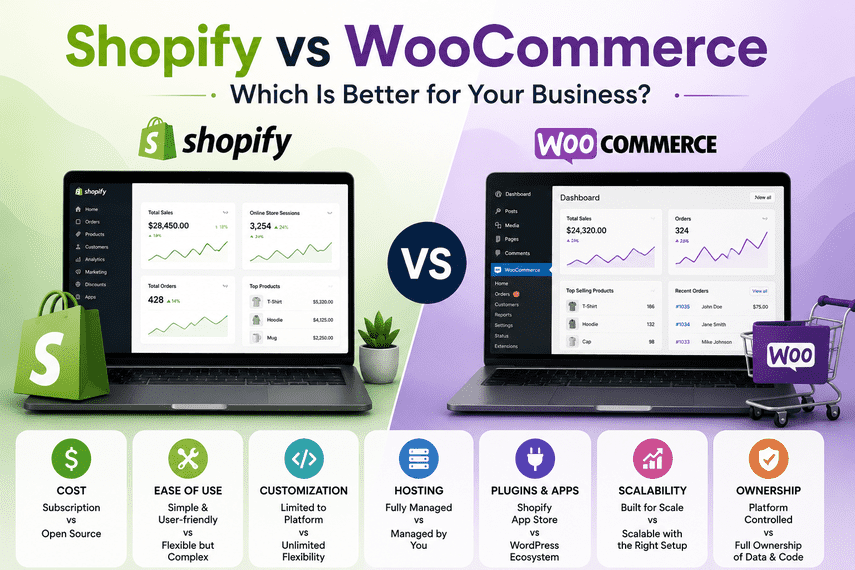
Shopify vs WooCommerce at a glance
| Factor | Shopify | WooCommerce |
|---|---|---|
| Platform model | Managed SaaS | Open-source ecommerce on WordPress |
| Hosting | Included | Managed separately |
| Infrastructure control | Lower | Higher |
| Initial technical complexity | Lower | Higher |
| Customization | Strong, within platform architecture | Very high |
| WordPress integration | Separate from WordPress | Native |
| Maintenance responsibility | Lower | Higher |
| Plugin/app ecosystem | Shopify App Store | WordPress/WooCommerce ecosystem |
| Data/code control | More platform-managed | Greater control |
| Scalability | Strong managed infrastructure | Depends heavily on architecture |
| Security responsibility | More platform-managed | Shared with merchant/hosting team |
| Best fit | Businesses prioritizing simplicity and speed | Businesses prioritizing flexibility and control |
This table is only a starting point.
The real decision requires looking underneath these labels.
First: Shopify vs WordPress is not exactly the same comparison
One of the keyword variations people search for is “Shopify vs WordPress.”
Technically, that comparison can be misleading.
Shopify is an ecommerce platform.
WordPress is primarily a content management system.
WooCommerce is the ecommerce platform/plugin that turns WordPress into an ecommerce environment.
WooCommerce’s own developer documentation describes it as an open-source ecommerce platform built on WordPress.
So when someone searches:
Shopify vs WordPress
they are often really asking:
Shopify vs WooCommerce running on WordPress.
That distinction matters because the technology and operational responsibilities are very different.
What is Shopify?
Shopify is a hosted SaaS commerce platform.
Instead of purchasing software and arranging your own hosting environment, the merchant subscribes to Shopify and operates the store through its platform.
Shopify includes commerce hosting, unlimited bandwidth, TLS/SSL for connected domains, themes, sales channels, and an application ecosystem.
This creates a fundamentally different operating model.
The merchant does not need to manage the underlying web server in the same way a self-hosted ecommerce business would.
That can be a significant advantage.
Shopify’s fundamental proposition is:
Spend less organizational energy operating the platform and more energy operating the business.
That doesn’t mean Shopify eliminates technical work.
Businesses can still require:
- Custom development
- Integrations
- Analytics
- Theme development
- App management
- SEO work
- Data migration
- Automation
- Custom workflows
But the underlying infrastructure is much more managed.
What is WooCommerce?
WooCommerce is open-source ecommerce software that operates within WordPress.
The business can choose its hosting provider, theme, plugins, extensions, development approach, integrations, and much of the underlying infrastructure.
WooCommerce’s documentation emphasizes its open-source nature, flexibility, extensibility, REST API, and ability to customize the store.
That creates a different proposition:
You get more control, but you also take on more responsibility.
A WooCommerce business may need to manage or coordinate:
- Hosting
- WordPress
- WooCommerce
- Plugins
- Themes
- PHP
- Database
- Caching
- CDN
- Security
- Backups
- Updates
- Performance
- Compatibility
- Custom development
This doesn’t mean every WooCommerce merchant needs a large technical team.
The ecosystem provides managed hosting, extensions, agencies, and tools.
But the underlying architecture remains more open than Shopify.
The biggest difference: control vs operational simplicity
This is the most useful way to understand Shopify vs WooCommerce.
Shopify
Less infrastructure control → less infrastructure responsibility
WooCommerce
More infrastructure control → more infrastructure responsibility
Neither side is automatically better.
It depends on what the business values.
Imagine two companies.
Company A
The owner wants to:
- launch quickly
- manage products
- run marketing
- sell internationally
- minimize infrastructure work
- use established apps
- avoid managing servers
Shopify may be an excellent fit.
Company B
The business wants:
- complete control of hosting
- custom WordPress functionality
- unusual product workflows
- custom integrations
- control over code
- specialized data structures
- deep content integration
WooCommerce may be a better fit.
The platform should match the operating model of the business.
Shopify vs WooCommerce: Cost
Cost is one of the areas where ecommerce platform comparisons become misleading.
People often ask:
Is Shopify cheaper than WooCommerce?
or:
Is WooCommerce free?
Neither question is sufficient.
Shopify costs
Shopify has subscription costs, payment-processing costs, and potentially costs for apps, themes, development, and other services.
Shopify’s current pricing varies by market and plan. Its India pricing page, for example, lists different subscription levels and notes that third-party transaction fees may apply when using third-party payment providers.
Shopify also has an app ecosystem where third-party products can introduce additional recurring or usage-based costs.
So the true Shopify cost is:
Platform + payment processing + apps + themes + development + integrations + services
WooCommerce costs
WooCommerce itself is open-source software.
But that doesn’t mean running a WooCommerce business costs nothing.
You may pay for:
- Hosting
- Premium plugins
- Themes
- Payment processing
- Development
- Security
- Backups
- Performance optimization
- Maintenance
- Monitoring
- Integrations
- Support
WooCommerce states that its core software is open source and that merchants can use extensions and other services to extend the platform.
Therefore:
WooCommerce’s software cost can be low while its operational cost can still be significant.
The correct way to compare cost
Don’t compare:
Shopify subscription vs WooCommerce software price.
Compare:
Total Cost of Ownership
TCO =
Platform
- hosting
- development
- apps/plugins
- integrations
- maintenance
- security
- payment costs
- infrastructure
- support
- migration
- internal staff
- opportunity cost
Then calculate that over 3–5 years.
This is a much more realistic comparison.
Shopify vs WooCommerce: Which is easier to manage?
For most businesses, Shopify is easier to operate at the infrastructure level.
Shopify provides managed commerce hosting, and its platform handles much of the underlying infrastructure.
With WooCommerce, the merchant has more control over the environment, which means more responsibility.
That can include keeping WordPress, WooCommerce, plugins, themes, and the hosting stack compatible.
WooCommerce’s developer documentation explicitly discusses WordPress and WooCommerce version compatibility and support windows, illustrating that maintaining the surrounding software ecosystem is part of operating the platform.
If your priority is:
“I want the least technical platform management possible.”
Shopify has an advantage.
If your priority is:
“I want maximum control over how the system works.”
WooCommerce has an advantage.
Shopify vs WooCommerce: Customization
This is where WooCommerce becomes particularly attractive.
Because WooCommerce is open source and operates within WordPress, developers can extend it using plugins, themes, hooks, APIs, and custom code. WooCommerce’s developer documentation provides extensive guidance for building custom extensions and themes.
That gives businesses considerable freedom.
You can customize:
- Product logic
- Checkout behavior
- Pricing
- Customer accounts
- Content
- Integrations
- Data
- Administrative workflows
- Frontend experience
Shopify is also highly extensible.
It has:
- Apps
- APIs
- Themes
- Extensions
- Shopify Functions
- Checkout extensibility
- Custom development capabilities
But Shopify’s customization happens within Shopify’s platform architecture.
That distinction is important.
WooCommerce:
You generally control more of the underlying environment.
Shopify:
You can extend a powerful platform without owning as much of the underlying infrastructure.
Shopify vs WooCommerce: Plugins and apps
Both platforms have large ecosystems.
Shopify has the Shopify App Store.
WooCommerce benefits from the broader WordPress plugin ecosystem and WooCommerce Marketplace. WooCommerce’s marketplace includes extensions for specialized functionality, with vendors responsible for maintaining and supporting their own products.
This creates an important benefit:
You don’t need to build everything yourself.
But it also creates a risk:
Every additional dependency adds complexity.
An app or plugin can introduce:
- Recurring cost
- Performance impact
- Security considerations
- Compatibility problems
- Vendor dependency
- Data synchronization
- Upgrade risk
Therefore, don’t choose a platform because:
“There is an app for everything.”
Ask:
How many dependencies will my business need to operate reliably?
Shopify vs WooCommerce: Performance
This is one of the most misunderstood comparisons.
It is tempting to ask:
Which is faster, Shopify or WooCommerce?
There isn’t a universal answer.
Actual performance depends on the implementation.
For WooCommerce, performance can be affected by:
- Hosting
- PHP
- Database
- Plugins
- Theme
- Queries
- Caching
- CDN
- Images
- Third-party scripts
- APIs
- Traffic
- Server configuration
A well-architected WooCommerce store can perform extremely well.
A poorly built WooCommerce store can be slow.
Shopify removes much of the infrastructure management, but the storefront can still be affected by:
- Theme implementation
- JavaScript
- Apps
- Images
- Third-party scripts
- Tracking
- Customizations
So the right question is not:
Which platform is fastest?
It is:
Can the platform and our implementation consistently deliver the performance the business requires?
That’s a much more useful engineering question.
Shopify vs WooCommerce: SEO
Both platforms can support successful SEO.
The platform itself is rarely the entire SEO strategy.
Organic performance depends on:
- Information architecture
- Content
- Internal linking
- Product/category structure
- Technical SEO
- Indexation
- Canonicals
- Structured data
- Performance
- Backlinks
- Search intent
- Content quality
- User experience
WooCommerce has an advantage for businesses already deeply invested in WordPress because content and commerce can live in the same ecosystem.
Shopify provides a managed environment where many technical fundamentals are handled for the merchant.
Neither platform guarantees rankings.
A technically perfect platform with weak content will not necessarily outrank a well-executed competitor.
Shopify vs WooCommerce: Security
Shopify’s managed model means Shopify handles significant portions of platform security and infrastructure.
Shopify states that its platform is Level 1 PCI DSS compliant and that Shopify-powered stores are PCI compliant by default.
With WooCommerce, the merchant has greater control but also more responsibility across the WordPress and hosting environment.
That can include:
- Keeping software updated
- Managing plugins
- Securing hosting
- Protecting administrator accounts
- Managing backups
- Monitoring vulnerabilities
- Controlling access
- Maintaining custom code
This doesn’t make WooCommerce inherently insecure.
It means:
The security model depends more heavily on how the environment is operated.
Shopify vs WooCommerce: Scalability
Both platforms can support substantial ecommerce businesses.
But scalability means more than:
“Can it handle more orders?”
You need to consider:
- Traffic
- Orders
- Catalog size
- Customers
- Search
- Checkout
- Integrations
- ERP synchronization
- Inventory
- Geographic expansion
- Operational complexity
Shopify
Much of the underlying infrastructure is managed by Shopify.
This reduces the amount of infrastructure engineering required from the merchant.
Shopify’s enterprise offering emphasizes managed infrastructure, high-volume commerce, and large-scale checkout capacity.
WooCommerce
Scaling is more dependent on architecture.
You may need to optimize:
- Database
- Hosting
- PHP
- Object caching
- CDN
- Queries
- Search
- Background jobs
- Plugin behavior
- APIs
This can be an advantage if your business needs deep control.
But it requires stronger technical capability.
Shopify vs WooCommerce for content-heavy businesses
This is where the WordPress foundation matters.
If your business depends heavily on:
- Publishing
- Editorial content
- Guides
- Education
- Community
- Content marketing
WordPress + WooCommerce can be particularly attractive because content and commerce are built within the same ecosystem.
That doesn’t mean Shopify cannot support content marketing.
It absolutely can.
The question is whether content is merely supporting commerce or is itself a major part of your business model.
Shopify vs WooCommerce for B2B
B2B changes the platform decision considerably.
You may need:
- Company accounts
- Multiple buyers
- Custom pricing
- Customer-specific catalogs
- Purchase orders
- Approval workflows
- Credit terms
- Sales-assisted orders
- Quotes
- ERP integration
Both ecosystems can support B2B scenarios, but the exact capabilities, implementation requirements, and plan levels need to be evaluated against the business model.
Shopify currently offers B2B capabilities across its plans, with additional capabilities available at higher tiers such as Shopify Plus.
WooCommerce can support B2B through extensions and custom development.
The key question is:
How much of the required B2B workflow is native, how much requires extensions, and how much requires custom development?
That’s more important than simply asking whether the platform “supports B2B.”
Shopify vs WooCommerce for international ecommerce
International selling introduces another layer of complexity:
- Multiple currencies
- Languages
- Tax
- Shipping
- Local payment methods
- Regional catalogs
- Pricing
- Domains
- SEO
- Inventory
- Legal requirements
Shopify provides international commerce features within its platform, while WooCommerce can achieve highly customized international setups through WordPress, extensions, and custom integrations.
Again, the trade-off is:
Shopify → more managed
WooCommerce → more controllable
For a business operating in many markets, you should evaluate the entire international architecture rather than just the storefront.
Shopify vs WooCommerce: Payments
Payment architecture is one area where the financial difference can become important.
Shopify offers Shopify Payments where available, alongside third-party payment providers. Shopify states that third-party transaction fees can apply when a merchant uses a third-party payment provider, with rates varying by plan and market.
WooCommerce itself does not require a proprietary payment processor. Payment processing is handled through the gateway/provider selected by the merchant.
WooCommerce describes its model as having no additional transaction fee beyond the payment service provider’s fees.
For a high-volume business, even a small difference in payment economics can become material.
So model:
Annual GMV × effective payment cost
rather than simply comparing monthly platform subscriptions.
Shopify vs WooCommerce: Ownership
This is a deeper strategic difference.
With WooCommerce, you can control:
- Hosting
- Code
- Database
- Files
- WordPress
- Plugins
- Data
- Infrastructure
With Shopify, the business operates within Shopify’s managed platform.
That creates a trade-off.
WooCommerce gives you more control.
But you have more responsibility.
Shopify gives you less infrastructure control.
But you have less infrastructure responsibility.
Neither model is inherently superior.
It depends on what your business wants to own.
What happens if your business grows?
This is where the platform decision becomes strategic.
A platform that works at $100,000 in annual sales may work differently at:
- $1 million
- $5 million
- $20 million
- $50 million
Not necessarily because the platform stops working.
The business around the platform becomes more complex.
You may add:
- Employees
- Warehouses
- ERP
- CRM
- PIM
- Multiple brands
- International markets
- B2B
- New channels
- Custom pricing
- Advanced analytics
The question becomes:
Can the platform remain the right architectural foundation as the business evolves?
That is a much better question than:
“Can Shopify/WooCommerce handle my sales volume?”
Shopify or WooCommerce: Who should choose what?
Shopify is usually the stronger choice when:
- You want managed infrastructure.
- Your internal technical resources are limited.
- Speed to market is important.
- You want to reduce platform maintenance.
- Your business requirements fit Shopify’s architecture.
- You prefer an ecosystem of apps rather than managing the underlying stack.
- Operational simplicity is a major priority.
WooCommerce is usually the stronger choice when:
- You already have a strong WordPress ecosystem.
- Content is strategically important.
- You need significant customization.
- You want more control over hosting and code.
- You have technical resources or a capable technology partner.
- Your business requires unusual workflows.
- You need deeper control of the underlying environment.
When Shopify may be the wrong choice
Don’t choose Shopify simply because:
“Everyone is moving to Shopify.”
It may be the wrong decision if:
- Your requirements conflict with the platform’s architecture.
- You require unusually deep infrastructure control.
- Your integrations require capabilities that are difficult to implement.
- App dependencies would become excessive.
- Your business economics make payment/platform costs unattractive.
- Your existing WordPress ecosystem is a major competitive advantage.
When WooCommerce may be the wrong choice
Don’t choose WooCommerce simply because:
“It’s open source and free.”
It may be the wrong decision if:
- Your organization doesn’t want to manage technical complexity.
- Nobody owns platform maintenance.
- Plugin dependencies are becoming excessive.
- Performance problems are recurring.
- Security and updates are poorly managed.
- Your business needs simplicity more than flexibility.
Open source gives you control.
Control without operational capability can become technical debt.
What about moving from WooCommerce to Shopify?
The keyword “WooCommerce to Shopify” is particularly interesting because it indicates a different search intent.
Someone searching this isn’t merely researching platforms.
They may already have a business problem.
Common reasons businesses consider moving from WooCommerce to Shopify include:
- Too much maintenance
- Plugin conflicts
- Security concerns
- Hosting problems
- Performance issues
- Difficulty scaling
- Lack of internal technical resources
- Desire for simpler operations
But migration should not automatically be the answer.
Before moving, ask:
What problem are we actually trying to solve?
If the problem is:
Slow website
→ diagnose the bottleneck first.
If the problem is:
Plugin conflicts
→ determine whether the architecture can be simplified.
If the problem is:
Hosting
→ evaluate whether better infrastructure solves it.
If the problem is:
Maintenance
→ compare the cost of professional management with migration.
If the problem is:
Platform limitations
→ then migration may become more compelling.
This is a crucial principle:
Don’t migrate because the current platform is difficult. Migrate when the current platform is creating a persistent business constraint that is worth the cost and risk of changing.
What about moving from Shopify to WooCommerce?
The same logic applies in reverse.
A business might consider Shopify → WooCommerce because it wants:
- More control
- Greater customization
- WordPress integration
- More control over data and infrastructure
- Specific functionality
- Different economics
- Greater control over integrations
But again:
More control isn’t automatically more value.
If the business doesn’t have the resources to operate the additional complexity, moving to WooCommerce may make the situation worse.
The real decision framework
If you’re deciding between Shopify and WooCommerce, evaluate both platforms across these eight areas:
| Area | Question |
|---|---|
| Business fit | Does the platform support how we sell? |
| Customer experience | Can it deliver the buying experience we need? |
| Technical fit | Does it integrate with our architecture? |
| Operational fit | Can our team operate it effectively? |
| Financial fit | What is the 3–5 year total cost? |
| Performance | Can our implementation meet performance requirements? |
| Scalability | Can it support our credible growth plans? |
| Strategic fit | Will it help or constrain our business strategy? |
Then score each platform.
But don’t let the spreadsheet make the decision for you.
Use it to expose the trade-offs.
Shopify vs WooCommerce: A practical scoring example
Imagine a business with these priorities:
- Simple operations: very important
- Limited technical team: very important
- Deep customization: moderate
- WordPress content: low
- Infrastructure control: low
- Fast implementation: very important
Shopify may score higher.
Now imagine another business:
- WordPress is central to the business
- Extensive custom functionality
- Strong technical team
- Custom ERP integration
- Complete infrastructure control
- Highly unusual workflows
WooCommerce may score higher.
Neither conclusion is universal.
The requirements determine the answer.
The most important mistake to avoid
Don’t choose a platform based on a feature checklist.
For example:
Shopify has 95 features.
WooCommerce has 110.
Therefore WooCommerce wins.
That is not how technology decisions should work.
A feature only has value if it solves a meaningful business requirement.
The better process is:
Business requirement
↓
Required capability
↓
Technical solution
↓
Platform
↓
Implementation
That keeps the business in control of the technology decision.
Shopify vs WooCommerce: Our recommendation
If you’re starting a straightforward ecommerce business and want to minimize technical overhead, Shopify is often the stronger default starting point.
If you’re building around WordPress, require significant customization, or need greater control over the underlying technology, WooCommerce can be the better choice.
For an established ecommerce business, however, we would not make the recommendation from platform preference alone.
We would first examine:
Business model → Customer experience → Operations → Integrations → Performance → Technology → Cost → Growth
Then determine which platform creates the best overall business outcome.
The platform is not the strategy
This is perhaps the most important conclusion.
Shopify is not a growth strategy.
WooCommerce is not a growth strategy.
Magento is not a growth strategy.
Technology is the infrastructure that allows the strategy to operate.
A business can have an excellent platform and still have:
- Poor conversion
- Weak merchandising
- Bad SEO
- Slow fulfillment
- Poor retention
- High acquisition costs
- Weak customer experience
And a business can succeed on a relatively simple platform because its:
- Product
- Brand
- Marketing
- Customer experience
- Operations
- Economics
are strong.
The best ecommerce platform is therefore not the platform with the longest feature list.
It is:
The platform that allows your business to achieve its goals with an appropriate level of cost, complexity, control, and risk.
Final verdict: Shopify vs WooCommerce
Choose Shopify if your priority is:
Simplicity + speed + managed infrastructure + lower technical responsibility
Choose WooCommerce if your priority is:
Flexibility + control + WordPress + customization + ownership
Choose neither simply because:
everyone else is using it.
The right platform is determined by your business.
And if you’re already operating an ecommerce store, the question becomes even more important:
Is your current platform actually holding your business back—or is the real problem somewhere else?
Before investing in a migration, find the constraint first.
A new platform can solve a technology problem.
It cannot automatically solve a business problem.
Frequently Asked Questions
Is Shopify better than WooCommerce?
Neither is universally better. Shopify is generally stronger for businesses prioritizing simplicity and managed infrastructure, while WooCommerce is stronger when control, WordPress integration, and customization are important.
Is WooCommerce cheaper than Shopify?
Not necessarily. WooCommerce’s core software is open source, but hosting, plugins, development, security, maintenance, and infrastructure can add significant costs. Shopify has subscription and potentially payment, app, theme, and development costs. Compare total cost of ownership rather than software price.
Which is better for SEO, Shopify or WooCommerce?
Both can support strong SEO. The quality of the site architecture, content, technical SEO, performance, internal linking, and overall strategy usually matters more than the platform choice alone.
Which is easier to manage?
Shopify generally requires less infrastructure management because hosting and much of the platform infrastructure are managed for you. WooCommerce gives you more control but also more responsibility.
Can WooCommerce scale?
Yes. WooCommerce can support large ecommerce operations, but the architecture, hosting, database, caching, plugins, integrations, and development practices become increasingly important as complexity and traffic grow.
Is Shopify good for large businesses?
Yes. Shopify offers higher-tier and enterprise capabilities for complex and high-volume businesses. The correct question is whether Shopify’s architecture fits the specific requirements of the business.
Should I migrate from WooCommerce to Shopify?
Not automatically. First identify why the current store is causing problems. If the underlying problem is infrastructure, plugins, architecture, or maintenance, the solution may not require a platform migration.
Should I migrate from Shopify to WooCommerce?
Only when the additional control and customization justify the additional operational responsibility. Moving platforms is a business transformation project, not simply a website rebuild.
TheCoachSMB perspective
At TheCoachSMB, we don’t believe ecommerce businesses should choose platforms based on popularity alone.
We believe technology should follow the business.
Before choosing Shopify, WooCommerce, Magento, or another platform, understand:
What does the business need?
What complexity can the organization operate?
What will the technology cost over several years?
What integrations are critical?
What does the business need to become?
Only then should the platform decision be made.
The right ecommerce platform isn’t the one with the most features.
It’s the one that gives your business the right foundation to grow.