
-
Jul, Thu, 2026

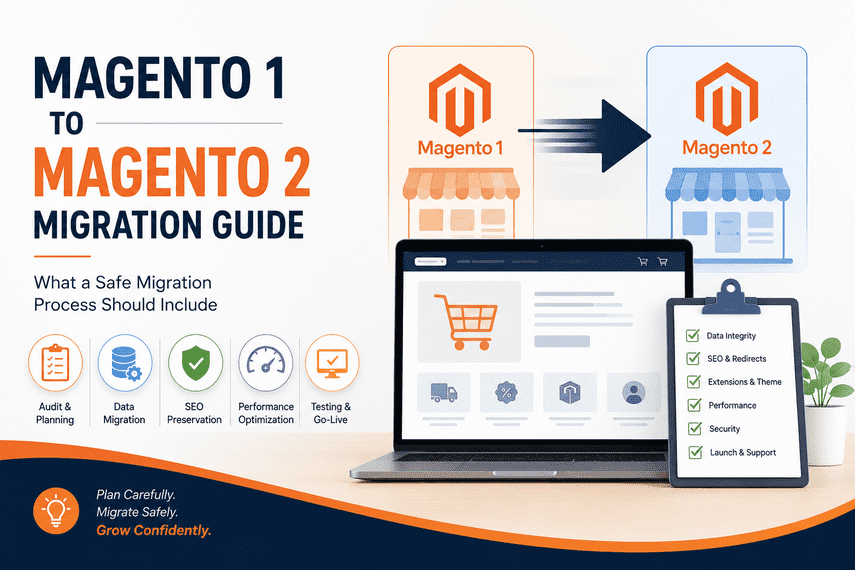
Magento 1 to Magento 2 Migration: A Complete Guide to Planning a Safe Migration
Table of Contents
If you’re running an ecommerce business on Magento 1, you’ve probably heard the same recommendation many times: migrate to Magento 2.
But the decision is more complicated than simply choosing a newer platform.
A Magento 1 store may still be generating revenue, serving customers and supporting the business reliably. That doesn’t automatically mean migration is urgent—or that Magento 2 is necessarily the right destination.
The more important question is:
Can your current platform continue to support where your ecommerce business is going?
If migration is the right decision, the next question becomes equally important:
How do you move to Magento 2 without damaging the business you’ve already built?
A safe Magento 1 to Magento 2 migration requires considerably more than moving products and customers. It involves understanding the existing store, rebuilding functionality, protecting SEO, validating business data, testing integrations and planning the transition carefully.
This guide explains what a professional Magento 1 to Magento 2 migration process should include, what commonly goes wrong, and how to evaluate whether a migration plan is actually safe.
Does Every Magento 1 Store Need to Migrate Immediately?
Not necessarily.
A store being built on Magento 1 doesn’t tell you whether migration should happen tomorrow.
Before committing to a migration, it is worth looking at the business as a whole:
- Is the store generating revenue reliably?
- Are there security or compliance concerns that cannot reasonably be addressed?
- How heavily customized is the current Magento 1 installation?
- Which extensions and integrations are business-critical?
- How much technical debt has accumulated?
- What functionality does the business need over the next 3–5 years?
- Can the current platform realistically support those requirements?
- Would Magento 2 solve the business’s future requirements?
- Would another platform, such as Shopify, make more sense?
The right question isn’t simply:
“How do we migrate Magento 1?”
It is:
“What platform should support the business over the next several years, and what is the safest way to get there?”
For some businesses, the answer will be Magento 2.
For others, it may be another ecommerce platform.
And in some cases, the immediate priority may simply be understanding the risks of continuing with the current Magento 1 implementation.
That assessment should happen before development begins.
Why Magento 1 to Magento 2 Isn’t a Simple Upgrade
One of the biggest misconceptions about Magento migration is treating it like a normal software update.
It isn’t.
Magento 1 and Magento 2 have fundamentally different architectures. Your Magento 1 theme cannot simply be copied into Magento 2, and Magento 1 extensions generally cannot be installed and expected to work on Magento 2.
Custom functionality needs to be understood and rebuilt.
The database structures are also different, which means data migration requires mapping and validation rather than simply copying database tables.
In practice, a Magento 1 to Magento 2 migration is closer to rebuilding the ecommerce platform while preserving the business-critical parts of the existing store.
That’s why experienced Magento 1 to Magento 2 migration services typically begin with discovery and assessment rather than immediately starting development.
The Magento 1 to Magento 2 Migration Process
A safe migration should follow a structured process.
The exact implementation will vary depending on the store, but the major phases should generally include:
Assessment → Planning → Architecture → Development → Data Migration → SEO Migration → Testing → Launch → Monitoring
Let’s look at each stage.
1. Start With a Complete Magento 1 Audit
Before moving anything, you need to understand what actually exists in the current store.
This sounds obvious, but established Magento stores often contain years of customizations, extensions, integrations and business rules that aren’t obvious from the storefront.
The audit should cover:
Platform
- Magento version
- PHP version
- Database version
- Server environment
- Cron configuration
- Caching
- Indexers
- Search
- Redis/Varnish configuration
Ecommerce functionality
- Product catalogue
- Categories
- Attributes
- Pricing rules
- Customer groups
- Promotions
- Tax rules
- Shipping methods
- Payment methods
- Checkout customizations
Extensions and custom code
- Installed extensions
- Active extensions
- Custom modules
- Rewrites
- Observers
- Custom checkout functionality
- Third-party integrations
Business integrations
Depending on the business, this might include:
- ERP
- CRM
- PIM
- Payment gateways
- Shipping providers
- Marketplaces
- Accounting systems
- Email platforms
- Search platforms
- Analytics
SEO
- URL structure
- Metadata
- Canonicals
- Robots directives
- XML sitemap
- Internal linking
- Redirects
- Indexed pages
- Organic landing pages
The objective isn’t simply to create a technical inventory.
It’s to understand:
What does the existing store actually do for the business?
2. Build a Migration Dependency Map
Once the current Magento 1 store has been audited, classify the existing functionality.
For each component, ask:
Keep → Rebuild → Replace → Remove
For example:
| Existing Functionality | Magento 2 Decision |
|---|---|
| Required business functionality | Rebuild |
| Magento 2-compatible extension | Replace/upgrade |
| Functionality already available natively | Use Magento 2 capability |
| Outdated extension | Remove |
| Custom integration | Rebuild/reconnect |
| Unused functionality | Remove |
This step is particularly important because a migration shouldn’t simply reproduce every piece of technical debt from the old store.
A migration is an opportunity to simplify the platform, not just recreate it.
3. Plan the Magento 2 Architecture
Before development begins, define what the new Magento 2 environment should look like.
This includes decisions around:
- Hosting infrastructure
- PHP
- Database
- Web server
- Cache
- Redis
- Search
- CDN
- Media storage
- Deployment process
- Monitoring
- Backup
- Security
The architecture should be based on the requirements of the business and expected traffic rather than simply copying the old environment.
This is also the point to identify performance requirements.
A Magento 2 migration shouldn’t finish with:
“The new site is live.”
It should finish with:
“The new platform is stable, secure and capable of supporting the expected workload.”
4. Rebuild the Theme and Frontend
A Magento 1 theme cannot simply be transferred to Magento 2.
The frontend needs to be rebuilt using Magento 2’s architecture.
However, this doesn’t mean the entire customer experience needs to be redesigned.
If the existing store has a strong brand and customers understand the current navigation, preserving what already works may be more valuable than redesigning everything.
The migration is an opportunity to evaluate:
- Navigation
- Product discovery
- Search
- Filters
- Product pages
- Cart
- Checkout
- Mobile experience
- Accessibility
- Page performance
The objective should be improvement without unnecessary disruption.
5. Review Every Extension
Extensions are one of the areas where Magento migrations can become unnecessarily complicated.
For every Magento 1 extension, ask:
- Is the functionality still required?
- Does Magento 2 provide this functionality natively?
- Is there a reputable Magento 2 version?
- Does the extension need custom development?
- Does another solution provide a better long-term approach?
Don’t automatically migrate every extension.
Some extensions may have been installed years ago for functionality that Magento now provides natively.
Removing unnecessary extensions can reduce:
- Technical complexity
- Maintenance
- Security exposure
- Conflicts
- Performance overhead
A successful migration should leave the business with a simpler platform where possible.
6. Migrate the Data Carefully
Data migration is one of the areas merchants are naturally most concerned about.
Depending on the store, this may include:
- Products
- Categories
- Product attributes
- Customers
- Customer addresses
- Orders
- Invoices
- Shipments
- Credit memos
- Reviews
- CMS pages
- CMS blocks
- Store configurations
- Tax rules
Magento provides a Data Migration Tool, but using the tool doesn’t remove the need for planning and validation.
Custom attributes, custom entities and customized Magento 1 installations can require additional mapping and development.
The important distinction is:
Data migration isn’t complete when the records appear in Magento 2.
It is complete when the migrated data has been validated against the original system.
7. Validate Migrated Data
A professional migration should include multiple validation stages.
For example:
Product validation
Compare:
- Product counts
- SKUs
- Prices
- Attributes
- Categories
- Images
- Stock information
Customer validation
Check:
- Customer counts
- Customer accounts
- Addresses
- Customer groups
Order validation
Check:
- Order counts
- Order totals
- Customer relationships
- Order statuses
- Invoices
- Shipments
- Credit memos
Content validation
Check:
- CMS pages
- CMS blocks
- Navigation
- Images
- Internal links
This is particularly important for established businesses with years of historical transaction data.
8. Protect SEO During the Migration
SEO is one of the easiest areas to damage during a Magento migration.
A technically successful migration can still become a business problem if important organic traffic is lost.
Before migration, establish the current SEO baseline.
Record important:
- URLs
- Organic landing pages
- Metadata
- Canonical URLs
- Indexation
- Internal links
- Structured data
- XML sitemap
- Search Console data
- High-value pages
- Backlinked pages
Then map the old URL structure to the new one.
Old URL → New URL
Where URLs change, appropriate 301 redirects should be implemented.
But SEO migration isn’t simply about redirects.
After launch, monitor:
- 404 errors
- Redirect chains
- Indexation
- Crawl errors
- Canonicals
- XML sitemap
- Organic traffic
- Organic landing pages
- Rankings
- Internal links
- Structured data
A good SEO migration treats search visibility as a business asset that needs to be protected—not something to check after launch.
9. Optimize Performance During the Migration
A Magento migration is also an opportunity to establish a better performance baseline.
Before migration, record the current performance of important page types:
- Homepage
- Category pages
- Product pages
- Search
- Cart
- Checkout
Then assess the new Magento 2 implementation.
Areas to review include:
- Server response time
- PHP performance
- Database queries
- Caching
- Redis
- Search
- JavaScript
- CSS
- Images
- Third-party scripts
- CDN
- Core Web Vitals
The objective isn’t to chase a perfect PageSpeed score.
The objective is to ensure that real customers can browse, search, add products to cart and complete checkout efficiently.
10. Test the Complete Customer Journey
A migration isn’t ready because the homepage looks correct.
The complete ecommerce journey needs to be tested.
Catalogue
- Product pages
- Categories
- Configurable products
- Bundles
- Search
- Filters
- Pricing
Customer accounts
- Registration
- Login
- Password reset
- Address management
- Order history
Cart and checkout
- Add to cart
- Quantity changes
- Coupons
- Shipping
- Taxes
- Payment
- Order confirmation
Integrations
- ERP
- CRM
- Payment gateways
- Shipping
- Analytics
- Search
- Other business systems
Devices
- Desktop
- Tablet
- Mobile
Testing should happen in a staging environment before production.
11. Use Multiple Migration Runs
One of the biggest mistakes is treating migration as a single event.
For a complex Magento store, it is safer to perform multiple migration runs.
A typical approach could be:
Migration test → Validation → Fixes → Second migration → Validation → Final migration
This allows the team to discover problems while there is still time to fix them.
The final migration should therefore be much less of a surprise.
12. Have a Clear Rollback Strategy
Even a thoroughly tested migration can encounter unexpected issues.
A launch plan should therefore include a rollback strategy.
Before launch, determine:
- What happens if checkout fails?
- What happens if an integration fails?
- What happens if orders aren’t being processed correctly?
- How will the previous environment be preserved?
- Who makes the rollback decision?
- How quickly can the previous environment be restored?
The goal isn’t to expect failure.
It’s to make sure that one unexpected problem doesn’t become a prolonged business interruption.
13. Plan the Final Cutover Carefully
The final production migration should be treated as a controlled business event.
Before the cutover:
- Complete final backups
- Confirm data synchronization
- Freeze appropriate changes
- Confirm DNS/hosting configuration
- Verify SSL
- Confirm payment gateways
- Confirm shipping
- Confirm email delivery
- Confirm analytics
- Confirm monitoring
- Confirm rollback procedure
After launch:
- Test checkout immediately
- Place test orders where appropriate
- Check critical integrations
- Monitor server performance
- Check error logs
- Check redirects
- Check Search Console
- Monitor customer support issues
The first hours and days after launch are particularly important.
Magento 1 to Magento 2 Migration Checklist
Use this as a high-level checklist when evaluating your own migration plan or a Magento migration partner.
| Area | Before Migration | During Migration | After Migration |
|---|---|---|---|
| Products | Audit | Migrate | Validate |
| Categories | Audit | Migrate | Validate |
| Customers | Audit | Migrate | Test login |
| Orders | Audit | Migrate | Reconcile |
| Extensions | Review | Rebuild/replace | Test |
| Custom code | Document | Rebuild | Test |
| Integrations | Document | Reconnect | End-to-end test |
| SEO URLs | Crawl | Map redirects | Monitor |
| Metadata | Export | Migrate | Validate |
| Checkout | Document | Rebuild | Test |
| Performance | Benchmark | Optimize | Monitor |
| Analytics | Document | Reconfigure | Verify |
| Security | Assess | Harden | Monitor |
| Backups | Verify | Maintain | Verify |
| Rollback | Plan | Test | Maintain |
Common Magento 1 to Magento 2 Migration Failures
Understanding what goes wrong can be just as useful as understanding the ideal process.
1. Treating migration as database transfer
Products and customers are moved, but the business functionality around them isn’t properly understood.
2. Rebuilding every old extension
Years of technical debt are recreated instead of evaluated.
3. Ignoring custom functionality
Important business rules hidden inside custom code are discovered too late.
4. Losing SEO value
URLs change without proper redirect mapping and validation.
5. Testing only the homepage
The homepage works while checkout, search or integrations fail.
6. Ignoring third-party systems
ERP, CRM, payment or shipping integrations aren’t properly tested.
7. Migrating only once
Problems are discovered during the final cutover instead of during earlier test migrations.
8. Launching without a rollback plan
The team has no clear response when something unexpected happens.
9. Focusing only on technology
The technical migration succeeds but important operational processes don’t.
10. Rushing the project
A heavily customized Magento store is given an unrealistic timeline simply to meet a launch date.
How Long Does a Magento 1 to Magento 2 Migration Take?
There isn’t a reliable single timeline for every Magento store.
The effort depends on:
- Catalogue size
- Number of customers and orders
- Custom modules
- Extensions
- Integrations
- Theme complexity
- Checkout customization
- Data requirements
- SEO complexity
- Testing requirements
As a broad planning guideline:
| Store Type | Typical Timeline |
|---|---|
| Small / relatively standard store | 4–6 weeks |
| Medium / customized store | 6–8 weeks |
| Complex / enterprise store | 8–16+ weeks |
These are planning ranges, not guarantees.
A heavily customized store may require substantially more discovery and development than another store with the same number of products.
Be cautious of a migration proposal that promises a complex Magento 1 store can be safely migrated in only a few days without first completing a detailed assessment.
Magento 1 to Magento 2 or Another Platform?
Magento 2 isn’t automatically the right destination for every Magento 1 business.
At the beginning of a migration project, compare the available options.
Continue with the existing Magento environment
May make sense when:
- The store is stable
- The business has no immediate platform requirements
- Migration risk is currently greater than the benefit
- There is a realistic strategy for managing the existing environment
Move to Magento 2 / Adobe Commerce
May make sense when:
- The business needs Magento’s flexibility
- Complex catalogue requirements are important
- Custom ecommerce functionality is strategically important
- Existing Magento expertise and integrations provide value
- The business expects to continue investing in a flexible ecommerce platform
Move to Shopify
May make sense for businesses that prioritize:
- Simpler platform management
- Reduced infrastructure responsibility
- Faster implementation
- A different approach to customization and operations
The right answer depends on the business.
Platform migration should follow the business strategy—not the other way around.
Questions to Ask Before Hiring a Magento Migration Partner
Before choosing a Magento 1 to Magento 2 migration agency, ask:
- How many Magento 1 to Magento 2 migrations have you completed?
- Have you migrated stores with similar customization?
- How do you audit the existing Magento 1 installation?
- How do you handle custom modules?
- How do you decide which extensions to keep?
- How do you validate migrated data?
- How do you preserve SEO?
- How do you handle URL changes?
- Do you provide a staging environment?
- How do you test integrations?
- How many migration test runs are performed?
- What is your rollback strategy?
- What happens if something fails after launch?
- What post-launch monitoring is included?
- Who is responsible for resolving migration issues after launch?
A migration proposal should explain the methodology, dependencies, validation process, risks and assumptions—not just the development timeline and price.
What Should a Magento Migration Plan Deliver?
Before approving a migration, you should be able to understand what you’re actually getting.
A strong migration plan should give you visibility into:
Before development
- Current-state audit
- Technical assessment
- Extension inventory
- Integration inventory
- SEO assessment
- Data migration strategy
- Migration architecture
During development
- Magento 2 environment
- Theme/frontend implementation
- Extension replacement
- Custom functionality
- Integration development
- Data migration
- SEO implementation
Before launch
- Staging environment
- Data validation
- Functional testing
- Checkout testing
- Integration testing
- SEO validation
- Performance testing
- Security review
- Migration rehearsal
- Rollback plan
After launch
- Production monitoring
- Error monitoring
- SEO monitoring
- Performance monitoring
- Integration monitoring
- Issue resolution
This makes the migration measurable rather than simply declaring the project complete when the new site goes live.
Final Thoughts
A Magento 1 to Magento 2 migration is not simply a technical upgrade.
It is a business transition.
The goal isn’t to move an old website onto a newer platform as quickly as possible.
The goal is to preserve what already works, remove unnecessary technical debt, protect valuable data and SEO, improve the customer experience, and create a platform capable of supporting the business’s next stage.
And sometimes, after evaluating the business properly, Magento 2 may not be the right destination. Another platform may be more appropriate.
The important thing is to make that decision before committing to the migration.
If Magento 2 is the right path, a structured migration process can significantly reduce the risk of data loss, SEO problems, broken integrations, performance issues and unnecessary downtime.
The safest Magento migration isn’t necessarily the fastest one. It’s the one where the business understands what is being changed, what is being protected, what could go wrong, and how those risks will be managed.
If you’re considering moving away from Magento 1, SMB Tech Solution’s Magento 1 Platform Assessment can help you understand whether your current platform is ready for continued growth, what risks should be addressed, and whether migration is actually the right next step.
About the Author
Sonal Motghare-Balpande is a Magento Certified Professional with more than 14+ years of experience working with Magento and ecommerce businesses.
She is the Founder of TheCoachSMB and SMB Tech Solution, where she works with ecommerce businesses on platform modernization, performance, technical risk and long-term ecommerce growth.
Her approach is straightforward:
Understand the business first. Then determine what the technology needs to do.
That means a Magento migration should not begin with “How quickly can we move the store?”
It should begin with:
“What does the business need from its ecommerce platform next—and what is the safest way to get there?”