
No products in the cart.
- Published: May 23, 2026 | Updated: May 23, 2026

Mage-OS 3.0 Features Explained: What’s New in the Latest Open-Source eCommerce Release
Table of Contents
The open-source eCommerce ecosystem is evolving rapidly, and the official release of Mage-OS 3.0 marks a major milestone for Magento developers, agencies, and store owners worldwide.
Built on Magento Open Source 2.4.9, Mage-OS 3.0 introduces several powerful improvements designed to modernize the platform, improve developer experience, and strengthen the future of open-source commerce.
For businesses running Magento stores, this release is important.
What Is Mage-OS?
Mage-OS is a community-driven initiative created to continue and strengthen the open-source Magento ecosystem.
The project focuses on:
- Long-term sustainability
- Community-driven innovation
- Faster modernization
- Better developer experience
- Modern technology compatibility
As eCommerce continues evolving, many merchants are looking for flexible, scalable, and future-ready alternatives within the Magento ecosystem — and Mage-OS is becoming an increasingly strong option.
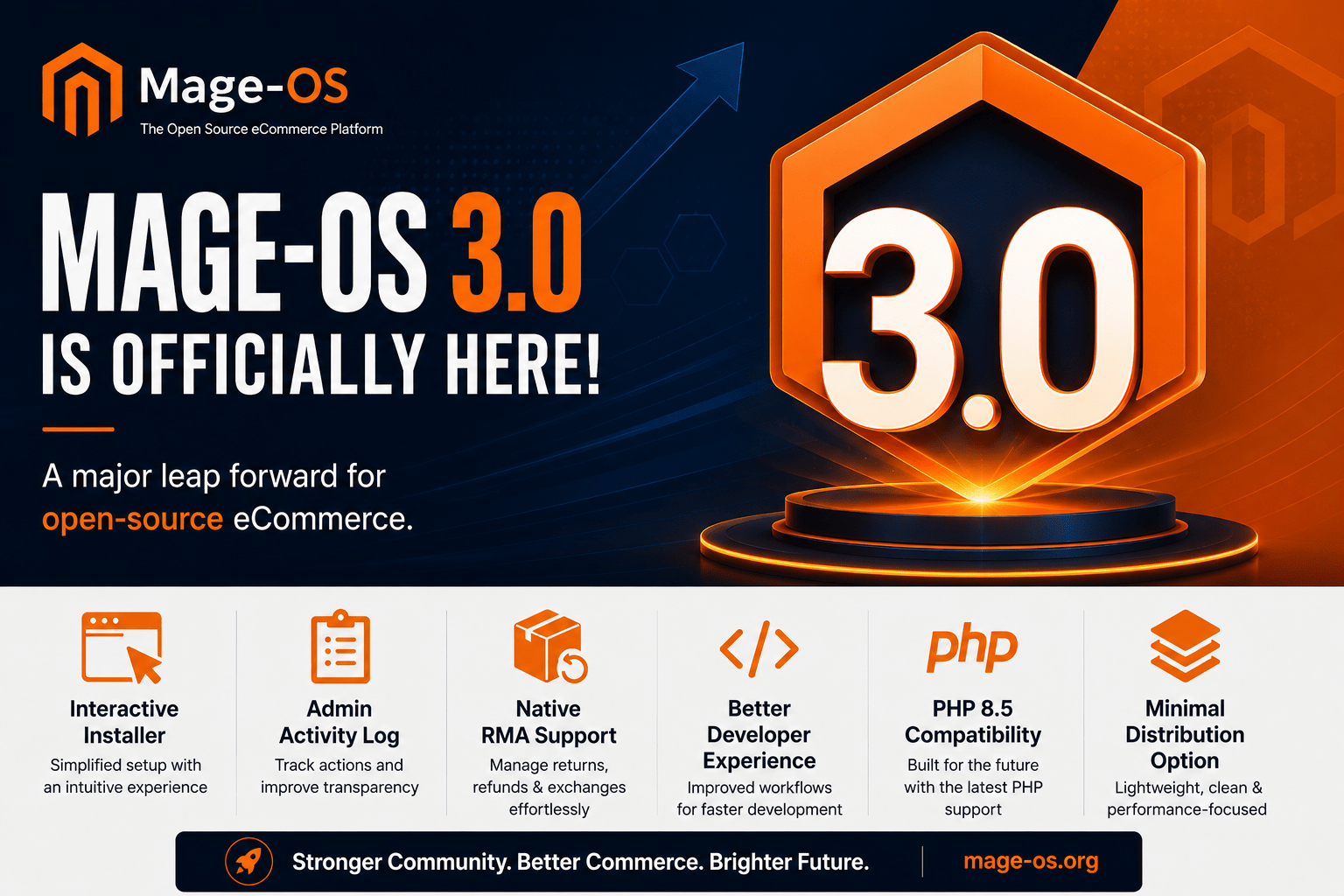
Key Mage-OS 3.0 Features
1. Interactive Installer
One of the biggest improvements in Mage-OS 3.0 is the new Interactive Installer.
This simplifies the setup process and helps developers deploy stores more efficiently.
Benefits:
- Faster installation process
- Easier onboarding
- Reduced setup complexity
- Better deployment experience
This feature is especially useful for agencies managing multiple Magento environments.
2. Admin Activity Log
Mage-OS 3.0 now includes a built-in Admin Activity Log.
This allows businesses to track backend actions performed by admin users.
Benefits:
- Improved transparency
- Better accountability
- Easier monitoring
- Enhanced security management
For growing eCommerce businesses with multiple administrators, this is a valuable feature.
3. Native RMA Support
Managing returns efficiently is critical in modern eCommerce.
Mage-OS 3.0 introduces native RMA (Return Merchandise Authorization) support, reducing dependency on third-party extensions.
Businesses can now manage:
- Product returns
- Refund requests
- Exchanges
- Customer return workflows
more effectively within the platform itself.
4. Better Developer Experience
Mage-OS 3.0 focuses heavily on improving the developer experience.
The release introduces improvements that help developers:
- Build faster
- Maintain cleaner codebases
- Improve workflows
- Reduce development friction
This is a major advantage for agencies and Magento development teams working on large-scale projects.
5. PHP 8.5 Compatibility
Modern PHP support is essential for:
- Security
- Performance
- Scalability
- Long-term stability
Mage-OS 3.0 supports PHP 8.5, helping stores remain future-ready and optimized for modern hosting environments.
This is particularly important for businesses planning Magento upgrades in 2026 and beyond.
6. Minimal Distribution Option
Mage-OS 3.0 also introduces a Minimal Distribution option.
This lightweight setup allows developers to create lean Magento environments with only the necessary components.
Benefits include:
- Faster deployments
- Reduced overhead
- Better performance optimization
- Greater customization flexibility
This approach is ideal for enterprise-level optimization strategies.
Mage-OS 3.0 vs Magento Open Source
Many merchants are now asking:
“Should we consider Mage-OS?”
The answer depends on your business goals and technical requirements.
Mage-OS continues to build upon the Magento Open Source foundation while focusing strongly on:
- Community innovation
- Faster modernization
- Open-source flexibility
- Developer-first improvements
For merchants who value long-term open-source commerce flexibility, Mage-OS is becoming a serious platform to watch.
Why Mage-OS 3.0 Matters for Store Owners
Outdated Magento stores often struggle with:
- Security vulnerabilities
- Slow performance
- Compatibility issues
- Difficult upgrades
- Increasing maintenance costs
Mage-OS 3.0 demonstrates that the open-source commerce ecosystem is actively evolving to solve modern eCommerce challenges.
Businesses that modernize early often gain:
- Better scalability
- Improved store performance
- Stronger customer experiences
- Faster development cycles
- Reduced technical debt
Should You Upgrade Your Magento Store?
If your Magento store is running on an outdated version, this is a good time to evaluate:
- Platform modernization
- Magento upgrade opportunities
- PHP compatibility
- Extension compatibility
- Performance optimization
A proper upgrade strategy can significantly improve:
- Site speed
- Security
- Stability
- Conversion rates
- Long-term maintainability
Common Magento Upgrade Challenges
Magento upgrades are powerful — but they must be handled carefully.
Common challenges include:
- Extension conflicts
- Theme compatibility issues
- Custom module failures
- Deployment downtime
- Data migration risks
This is why businesses should work with experienced Magento upgrade specialists.
How SMB Tech Solution Helps Magento Businesses
At SMB Tech Solution, we help businesses with:
- Magento upgrades
- Mage-OS migration
- Performance optimization
- Extension compatibility fixes
- Store modernization
- Ongoing Magento support
Our goal is to help eCommerce businesses build scalable, secure, and future-ready online stores.
Final Thoughts
Mage-OS 3.0 is more than just another release.
It represents the continued evolution of open-source commerce and highlights the strength of community-driven innovation.
For Magento developers, agencies, and merchants, this release opens exciting opportunities for:
- modernization,
- scalability,
- better development workflows,
- and long-term platform sustainability.
The future of open-source eCommerce continues to move forward — and Mage-OS 3.0 is an important step in that journey.